

The Pope and the Latin America trip: what we know and what the risks are
Bruni: Leo XIV wants to leave on 6 November for Uruguay, Argentina and Peru. After lung surgery, the doctors will decide
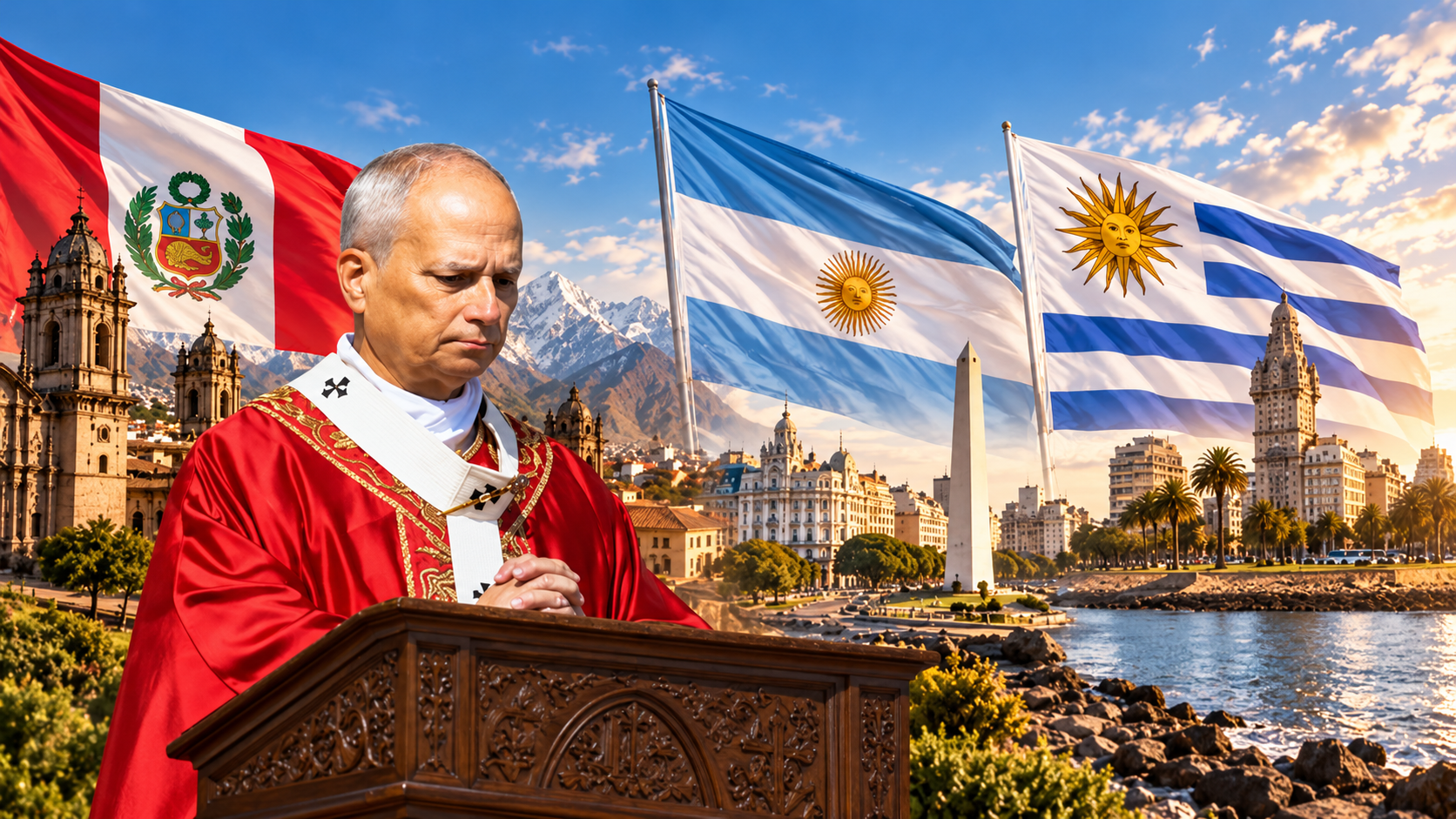
Leo XIV wants to make his apostolic journey to Uruguay, Argentina and Peru from 6 to 17 November. Holy See Press Office director Matteo Bruni told journalists so yesterday, 14 October, the day after the Pope's surgery at Rome's Gemelli Hospital for a lung adenocarcinoma. Bruni presented the medical bulletin, which describes a regular recovery, and said that «the Pope is well, his mood is good». For now the trip has been neither postponed nor scaled back.
The longest journey of the pontificate. The trip was announced on 5 August: twelve days and ten cities. As Vatican News wrote, it beats the record set by April's journey to Africa. It would be Leo XIV's seventh international journey, after Türkiye and Lebanon in November 2025 and, in 2026, Monaco, Africa, Spain and France. The official programme, released by the Press Office on 21 September, has the Pope leaving Fiumicino at 7:00 on 6 November and landing in Montevideo at 16:30 local time. The first day includes the welcome ceremony in Plaza Independencia and a meeting with authorities and the diplomatic corps.
The stops. In Uruguay, from 6 to 8 November, the Pope will visit Montevideo, Paysandú and Florida: a country no Pope has visited in about forty years, since John Paul II. In Argentina, Pope Francis's homeland, from 8 to 11 November, the stops are Buenos Aires, Córdoba and Luján. Peru, from 11 to 17 November, is the heart of the journey. Prevost lived there for more than twenty years as a missionary, parish priest, formator and bishop, and there he is called «el Papa peruano». The stops are Lima; Chiclayo, the diocese he led from 2015 to 2023; Cusco; and Pucallpa, in the Peruvian Amazon, where a meeting with indigenous peoples is planned. The return to Fiumicino is scheduled for 10:25 on 17 November.
The reports. Already after the Angelus of 11 October, according to La Verità, the Pope «was trying to do everything possible» to confirm the trip. The paper describes a «particularly demanding» journey, with «some twenty flights and helicopter transfers», which the Pope cares about deeply, above all for his return to Chiclayo, where the faithful still call him «padre Roberto». According to La Verità, the speed of the surgery and recovery also reflects this: the Pope does not intend to give up the trip. The same paper sees his attendance in Assisi on 27 October, at the meeting with leaders of other religions, as more uncertain. These are unconfirmed reports: the Vatican has announced no change to either the trip or the Assisi event.
The medical timeline. There are 24 days between the 13 October surgery and departure. Guidance on flying after chest surgery varies. The Aerospace Medical Association advises waiting 2-3 weeks after uncomplicated thoracic surgery; IATA, the international airline association, indicates 11 days. The British Thoracic Society advises one week after removal of the last chest drain, while Britain's National Health Service (NHS) suggests up to 6 weeks. A published study of these guidelines notes that they rest mainly on expert opinion rather than solid evidence, and that doctors apply them differently in practice. All agree, however, that a pneumothorax, air between the lung and the chest wall, rules out flying until it has resolved.
The risks for a patient like the Pope. Leo XIV is 71 and has just had a lobe of his lung removed. Asked by Adnkronos Salute, pulmonologist Claudio Micheletto said that «if there are no complications and all goes well, it would be within the timeframe», but that twenty days seemed «a bit short» to him: «This means facing a journey of many hours, and then internal transfers there too. It seems rather demanding to me». Guidelines for flying after surgery point to three further concerns. The first is thrombosis: recent surgery and cancer raise the risk on long flights, and high-risk patients are advised to use compression stockings and anticoagulants. The second is oxygen: with part of a lung removed, blood oxygen can drop at altitude, so a fitness-to-fly test and in-flight oxygen may be arranged. The third is altitude: the programme includes a stop in Cusco, at about 3,400 metres above sea level.
What to expect. The decision will depend on checks in the coming days and above all on the final histological examination, which will establish the stage of the disease and whether further treatment is needed. Vatican sources quoted by Corriere della Sera say doctors are not currently talking about chemotherapy. Bruni confirmed a hospital stay of about a week from admission; audiences are cancelled until Tuesday 20 October. Any final confirmation of the trip, or changes to the programme, will have to come from the Press Office.
Source: Sala Stampa della Santa Sede