

Pope Leo XIV, the Curia and the Jubilee legacy: appointments, rules and the final count
New prefects, an end to the IOR's exclusive role, new Curia regulations; and the Holy Year's 33.4 million pilgrims and the works left to Rome
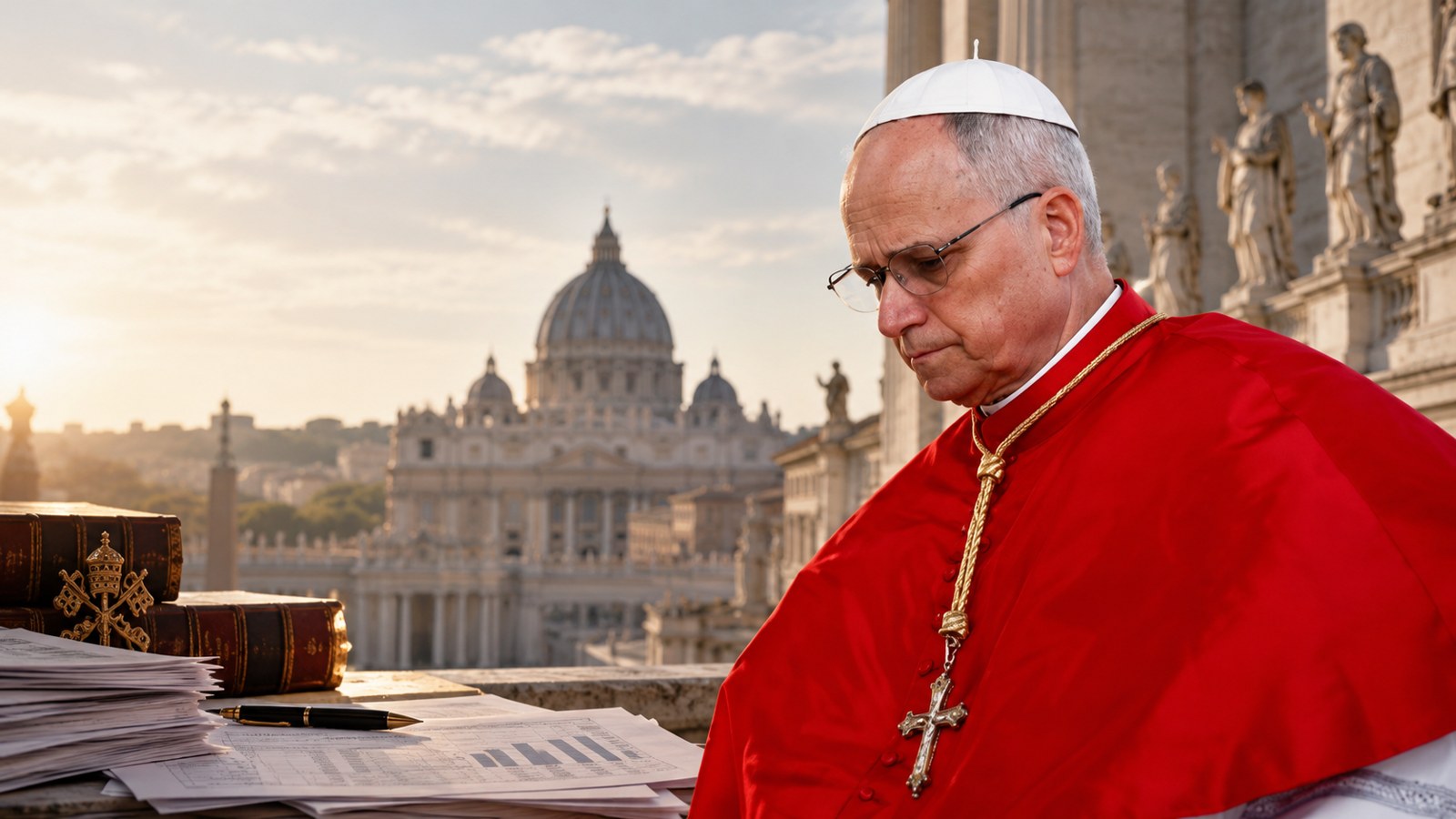
Two projects have marked the first seventeen months of Pope Leo XIV: the Roman Curia, which the Pope has begun to renew at a measured pace, and the 2025 Jubilee, proclaimed by Pope Francis and closed by his successor on 6 January 2026. For both, official sources now allow a first assessment.
The Curia: first appointments. In the months after his election on 8 May 2025, the Curia remained largely the one inherited from Pope Francis. The first appointment came on 22 May 2025: Tiziana Merletti, of the Franciscan Sisters of the Poor, as Secretary of the Dicastery for Institutes of Consecrated Life and Societies of Apostolic Life (Vatican News). On 26 September 2025 Pope Leo XIV entrusted the Dicastery for Bishops, which he had led as a cardinal since January 2023, to Filippo Iannone, a Carmelite and until then Prefect for Legislative Texts, also naming him President of the Pontifical Commission for Latin America (Holy See Press Office). On 25 March 2026 the Australian Anthony Randazzo, until then Bishop of Broken Bay, became Prefect for Legislative Texts with the personal title of Archbishop (Holy See Press Office); on 30 June Marco Mellino was named its Secretary.
The Curia: Charity and the Secretariat of State. On 12 March 2026 the Spanish Augustinian Luis Marín de San Martín, Undersecretary of the General Secretariat of the Synod, was appointed Papal Almoner and Prefect of the Dicastery for the Service of Charity, succeeding Konrad Krajewski, who became Archbishop of Łódź (Vatican News). On 30 March Paolo Rudelli, Nuncio to Colombia, became Substitute for General Affairs, replacing Edgar Peña Parra, who was sent as Nuncio to Italy and San Marino in place of Petar Rajič, himself named Prefect of the Papal Household (Vatican News). Earlier, on 19 November 2025, the Nigerian Anthony Onyemuche Ekpo had been named Assessor (Holy See Press Office).
The Curia: women leading dicasteries. In June 2026 Maria Montserrat Alvarado, President and COO of EWTN News, was appointed Prefect of the Dicastery for Communication from 1 November, succeeding Paolo Ruffini. According to Vatican News she is the first woman who is not a religious sister to head a dicastery (Vatican News). On 30 June Alessandra Smerilli, a Salesian sister, became Prefect of the Dicastery for Promoting Integral Human Development, succeeding Michael Czerny, with Fabio Baggio as Pro-Prefect and Jozef Barlaš as Secretary, from 1 September (DPIHD). On 8 October Mary Teresa Barron, former President of the UISG, was named Adjunct Secretary of the Dicastery for Evangelization and President of the Pontifical Mission Societies, effective 4 January 2027 (Vatican News).
The Curia: the rules. With the motu proprio Coniuncta cura, signed on 29 September 2025 and in force from 6 October, the Pope repealed the rescript of 23 August 2022 that gave the IOR exclusive competence over asset management. APSA now "generally" uses the IOR's structure, unless the Investment Committee deems it "more efficient or convenient" to use intermediaries in other countries (Vatican News). On 23 November 2025 he signed the new General Regulations of the Roman Curia and the Staff Regulations, which replace the 1999 text and implement the constitution Praedicate Evangelium (Vatican News).
The Curia: the direction. According to Vatican News, the choices reflect what Pope Leo XIV told journalist Elise Allen: that he intends to follow Pope Francis in entrusting women with leadership roles. With Smerilli and, from 1 November, Alvarado, the number of women prefects rises to three, alongside Simona Brambilla, appointed by Pope Francis. Diplomatic experience (Rudelli, Peña Parra, Rajič) and canon law expertise (Iannone, Randazzo) also stand out. Meanwhile George Jacob Koovakad, a cardinal and Prefect of the Dicastery for Interreligious Dialogue, is in the United Kingdom for meetings with Hindu, Jain and Sikh communities: the Bishops' Conference of England and Wales gives the dates as 16-22 October, while Vatican News says he has been in London since 13 October (CBCEW, Vatican News). There has been no official announcement of dicastery mergers.
The Jubilee: the pilgrims. The Holy Year's assessment was presented on 5 January 2026 at the Holy See Press Office. Rino Fisichella, Pro-Prefect of the Dicastery for Evangelization, announced 33,475,369 pilgrims from 185 countries, against a projection of about 31 million by Roma Tre University, and 35 "major events" (Vatican News). The agency SIR, reporting on the same press conference, gives an estimate of between 33.4 and 33.8 million by the closing date and an average of 90,400 people a day; according to the same data, 62.63% came from Europe and 16.54% from North America, with Italy first (36.34%), ahead of the United States (12.57%) and Spain (6.23%) (AgenSIR). Fisichella thanked 5,000 year-round volunteers and 2,000 from the Order of Malta; Francesco Rocca, President of the Lazio Region, reported 580,000 emergency (118) interventions and 1.6 million emergency-room visits.
The Jubilee: works and costs. Roberto Gualtieri, Mayor of Rome and the Government's Extraordinary Commissioner, reported 332 projects, 204 of them completed or partially completed, and 110 of the 117 in the first decree completed (commissari.gov.it). The City of Rome quotes him: «Sono stati investiti oltre 1,7 miliardi di euro e il 75% delle risorse è già stato utilizzato» ("More than €1.7 billion has been invested and 75% of the resources have already been used", our translation) (Roma Capitale). ANSA instead puts spending at 70%, while the Commissioner's office and ANSA both give about 90% for the urgent projects (ANSA). The Holy See did not release a financial statement of its own expenses.
The Jubilee: what remains. Gualtieri cited awards for Piazza Pia (The Plan Award 2025) and the Monte Ciocci path (European Green Award 2025), tent facilities for more than 900 homeless people and the "Fratelli Tutti" project with prisoners (AgenSIR). Alfredo Mantovano, Undersecretary to the Prime Minister's Office, described the "Jubilee method" as that of «un'amministrazione statale che deve coordinare e non dirigere altre amministrazioni» ("a state administration that must coordinate, not direct, other administrations", our translation), to be reused starting with the eighth centenary of the death of St Francis of Assisi. For Fisichella, the Holy Year achieved the aim of the bull Spes non confundit: «essere per tutti occasione di rianimare la speranza» ("to be for everyone an opportunity to rekindle hope", our translation).
In brief. On one side, a Curia changing through appointments and regulations, within the framework of Praedicate Evangelium; on the other, a Jubilee that exceeded forecasts and leaves Rome new works and a model of cooperation between institutions. Still unknown: a final pilgrim figure after 6 January, an account of the Holy See's expenses and a final statement on the works.
Sources: Holy See Press Office, Vatican News, Roma Capitale, Extraordinary Commissioner, ANSA, AgenSIR, CBCEW.
#LeoXIV #Vatican
Source: Sala Stampa della Santa Sede