
Leo XIV and artificial intelligence: from his name to Magnifica humanitas and Nvidia's reply
From the 2025 address to the cardinals to the encyclical and the exchange with Jensen Huang: the theme that defines the pontificate
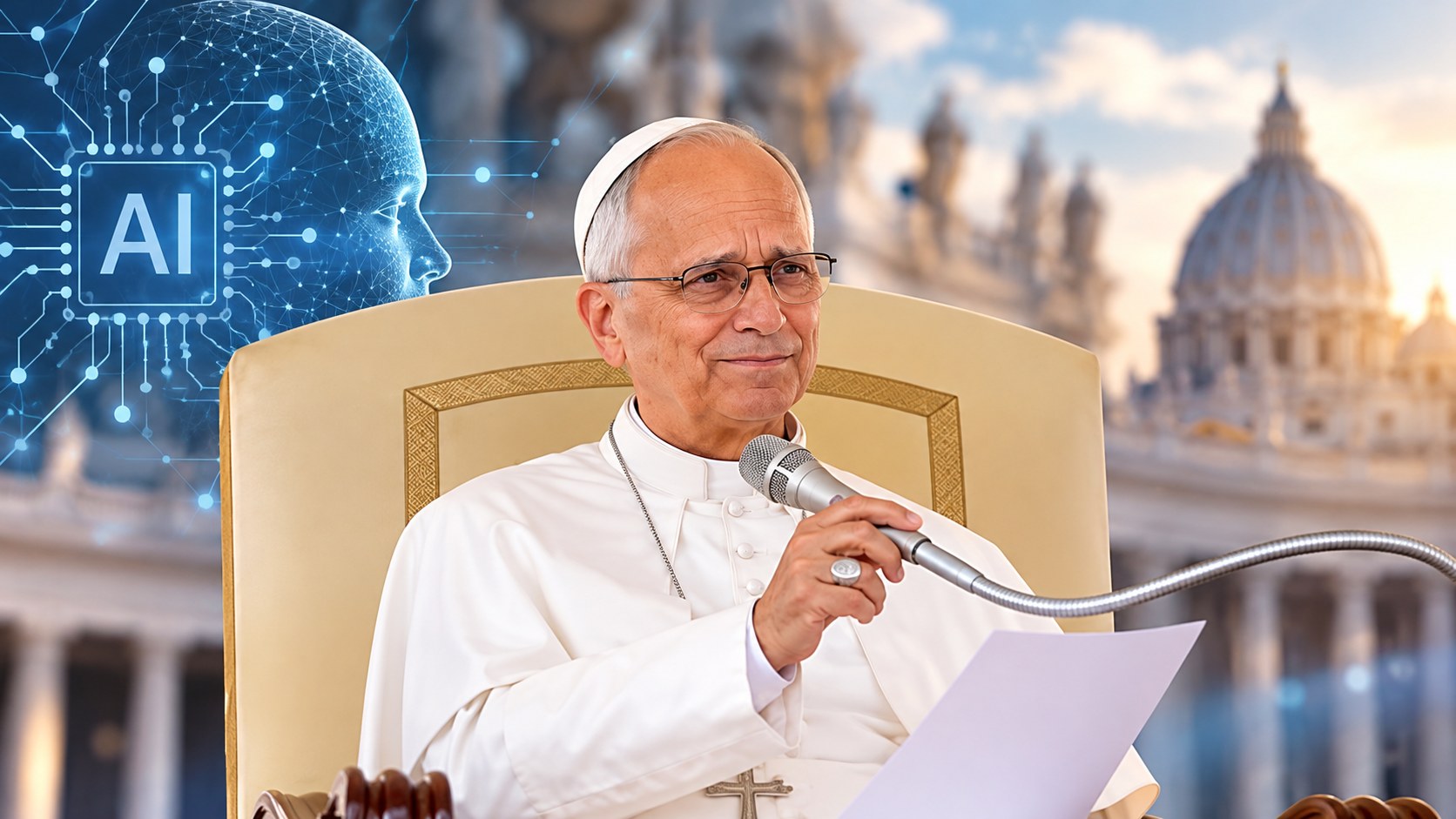
The name. The thread begins on 10 May 2025, two days after the election. In his address to the College of Cardinals, Leo XIV explained his choice of name: "There are different reasons for this, but mainly because Pope Leo XIII in his historic Encyclical Rerum Novarum addressed the social question in the context of the first great industrial revolution. In our own day, the Church offers to everyone the treasury of her social teaching in response to another industrial revolution and to developments in the field of artificial intelligence that pose new challenges for the defence of human dignity, justice and labour." This is the official text published by the Holy See.
The encyclical. A year later, the theme became the first major document of the pontificate. The Encyclical Letter Magnifica humanitas, "on safeguarding the human person in the time of artificial intelligence", was signed on 15 May 2026, the 135th anniversary of Rerum Novarum, and published on 25 May, according to the Holy See Press Office Bulletin. It is Leo XIV's first encyclical. The link to Leo XIII is explicit: today "we cannot limit ourselves simply to repeating his teachings", but must ask God "for the wisdom to interpret the great trends of our time, particularly technological advances" (no. 4).
The content. Chapter three, "Technology and Dominance. The Grandeur of Humanity in Light of the Promises of AI", takes up the critique of the "technocratic paradigm" already made by Pope Francis. According to Vatican News, the text states that AI can imitate and simulate the person but has no moral conscience, calls for clear accountability at every stage of development, independent oversight and user education, and warns against the concentration of technological power in the hands of a few. Other chapters address truth and democracy, education, the dignity of work in the digital transition and AI in weapons. According to NBC News, the Pope presented the encyclical in person at a Vatican event alongside Anthropic co-founder Christopher Olah.
The press conference. On 28 September 2026, on the return flight from Metz at the end of a four-day trip to France, the Pope answered a question on catastrophic AI risks. The transcript was published by ZENIT; the remarks were also reported by Reuters, NBC News and Axios. "If someone were to ask me, am I in panic mode? No, I'm not. I sleep at night," he said. "I do think that the concerns raised by many of the experts, specialists in AI, should be taken seriously. I don't think that is fake news, as some have said, to try and cause whether financial or some other kind of benefit." Reuters and Axios read the remarks as a rebuke to President Donald Trump, who had called AI fears a "hoax".
Nvidia. In the same answer the Pope referred to Nvidia's chief executive, Jensen Huang, without naming him: "Just today I read that the head of NVIDIA claims that he has found some way of inserting into AI certain guardrails, if you will, or limits." He added: "He's the same one, however, that says there should be no limits placed and no government regulation." Then the appeal: "This is a problem that I think we need to sit down and talk about." The Pope recalled that the Vatican has set up its own commission on artificial intelligence and that many contacts followed Magnifica humanitas. The aim, he said, is "to promote dialogue, study, investigation, to find ways to make sure that AI does not get to a point where it could destroy humanity." He said he was "relatively optimistic".
Huang's reply. On 14 October Huang responded in an interview with Fortune. "He's asking all the right questions, and he's thinking about all the right issues," he said of the Pope. But he defended the company: "I'm not exactly sure what was intended, but the facts are that few are doing as much in advancing AI safety in a way that helps the entire industry as we are." Huang cited Nvidia's open-source safety technology and its work on audit, governance and standards. "We can always talk about hypothetical incidents that have not happened, but as an engineer, we should develop the technology and methodologies and practices to deal with the incidents that have happened," he added. He pointed to common ground: "We all care about the same thing, which is an optimistic future where this technology has great positive impact in society while doing it with great responsibility, safety, and accountability." Fortune notes that Huang had told CBS News he agreed with Trump that AI safety concerns were overblown. He did not change his position on regulation in the interview.
The picture. From the name to the encyclical, and now to a public exchange with the largest maker of AI chips, artificial intelligence remains the theme Leo XIV has placed at the centre of his pontificate. The Holy See has not commented on Huang's interview. The Pope is in hospital at the Gemelli Polyclinic following surgery on 13 October.
Source: Santa Sede – Lettera Enciclica Magnifica humanitas