

Josephus and Jesus: the Testimonium debate returns
A 2025 Oxford University Press study argues the passage on Jesus is authentic and tied to sources close to his trial. Other scholars disagree
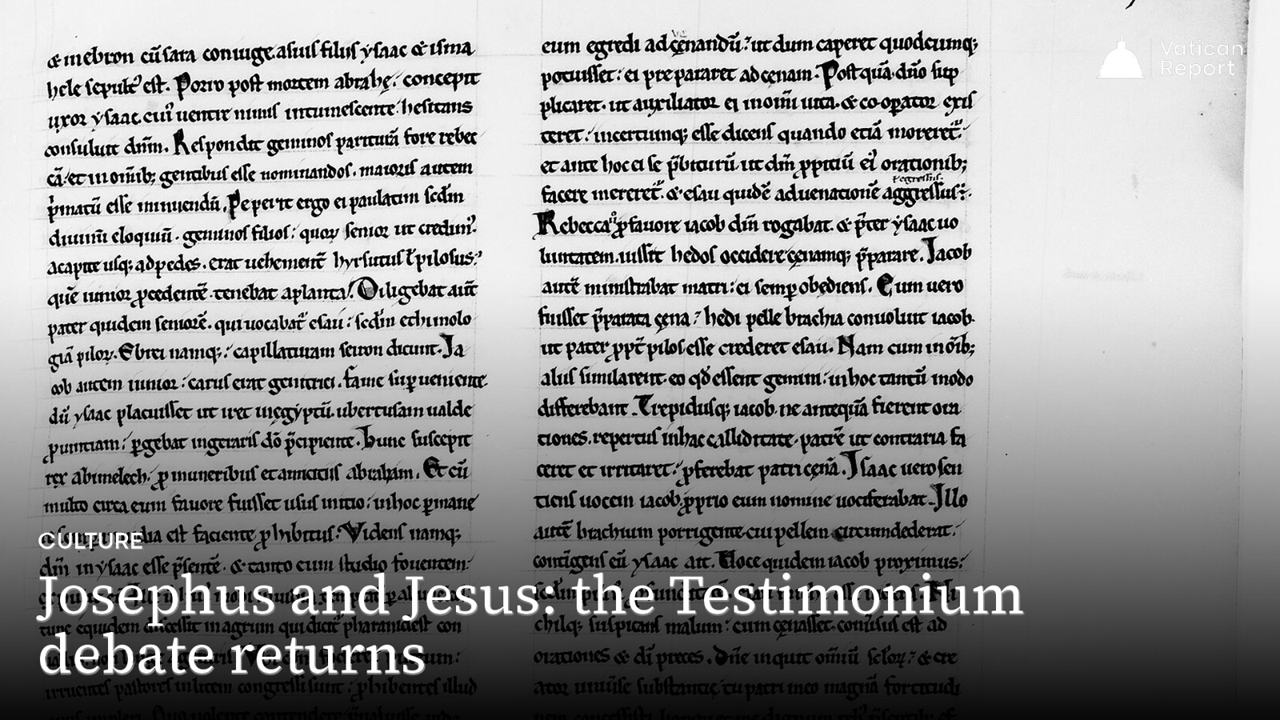
A passage of a few lines, written around AD 93-94, is back at the centre of scholarly debate. It is the Testimonium Flavianum, the section of the Jewish Antiquities (18.63-64) in which the Jewish historian Josephus writes about Jesus. Whether it is authentic or was reworked by Christian copyists has been argued for centuries. A thesis from a book published by Oxford University Press in 2025 is now circulating on social media as a "new analysis": it is neither a new discovery nor an established fact, but one author's proposal, which other scholars dispute.
Schmidt's thesis. In Josephus and Jesus: New Evidence for the One Called Christ (Oxford University Press, online since 5 May 2025, in print since June 2025, open access), Thomas C. Schmidt, who teaches religious studies at Fairfield University (United States), argues that the Testimonium is essentially the work of Josephus. In his view the text has lost only two or three words, which survive in Greek, Latin, Syriac, Arabic and Armenian witnesses: the Syriac version, for example, would say that Jesus "was thought to be" the Christ, not that he "was" the Christ. Schmidt also relies on a statistical analysis of style, which he says matches Josephus, and notes that early Christian readers did not read the passage as a profession of faith.
Ananus II and the trial. In the second part Schmidt proposes that Josephus personally knew some of the "first men among us" who, according to the Testimonium, accused Jesus. His most likely candidate is the high priest Ananus II, son of Annas and brother-in-law of Caiaphas, who, as Josephus himself reports, had James, "the brother of Jesus who was called Christ", put to death in 62 (Jewish Antiquities 20.200). Hence his conclusion that the passage may reflect information close to the trial.
How scholars have responded. The book has reopened the debate:
- Daniel M. Gurtner, in Religious Studies Review (March 2026), calls it a work of great ingenuity that gives grounds to question the consensus, but says it remains an open question whether its historical conclusions will stand.
- Steve Mason, in the Irish Theological Quarterly (January 2026), says the case for authenticity must be taken seriously, while the more sensational claims about informants, starting with Ananus II, do not in his view explain the evidence well.
- Daniel R. Schwartz, in the Journal of Jewish Studies (14 October 2026), rejects the thesis: after reviewing Schmidt's arguments, he upholds the consensus that the Testimonium is the product of Christian editing, which also undercuts the idea of Jewish informants behind the text.
What we don't know. No Greek manuscript contains the wording "thought to be the Christ" proposed by Schmidt, and no ancient source names Ananus II or anyone else as Josephus' informant: these are the author's reconstructions. The debate remains open.
Sources: Oxford University Press, Josephus and Jesus (DOI 10.1093/9780191957697.001.0001), Religious Studies Review, Irish Theological Quarterly, Journal of Jewish Studies.
#LeoXIV #Vatican
Source: Oxford University Press